BLUG: Conference review

BLUG started for me on monday afternoon when driving from my office to Brussels.Took me about 3 hours for 250 kilometers. Arrived at the hotel at 7:00 pm where Theo and some of the conference speakers already sat at the bar and had a beer or two.

After I was introduced by Theo to Belgian beer, we went downstairs for the speaker’s briefing and a dinner. After more beer and a lot of conversation, Day 0 ended at 1:30 am.
The night was short but somehow I managed to move my body to the breakfast room at 6:30 am.

Later on, I put Tim Clark, Paul Withers and Martin Leyrer into my car and we drove to the IBM Forum Brussels. The first thing we saw was the yellow Lotus car in front of the building.

The conferenc started with a keynote speech from Alistair Rennie followed by Laurent Boes talking about the latest Lotusphere announcenents in complement to the OGS.
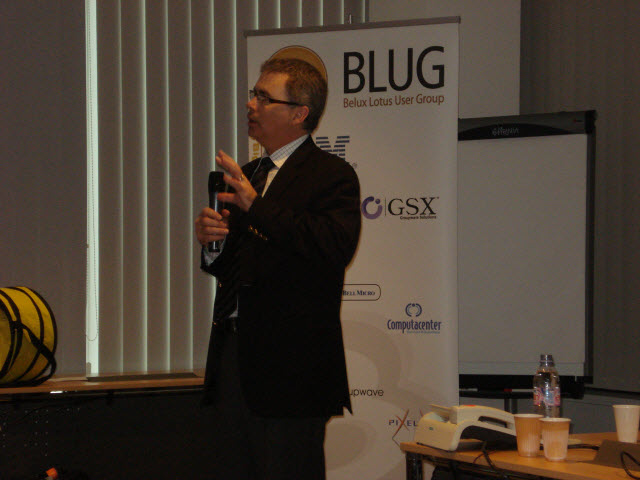
The breakout sessions started after a short coffee break. The forum staff did a great job in dividing one big room into 3 for the upcoming sessions. The technical staff was always available to fix minor problems or get the microphone to work properly.

All sessions were well attended. The developer track had 3 sessions in a row about XPages. The rooms was crowded; no surprise is that.
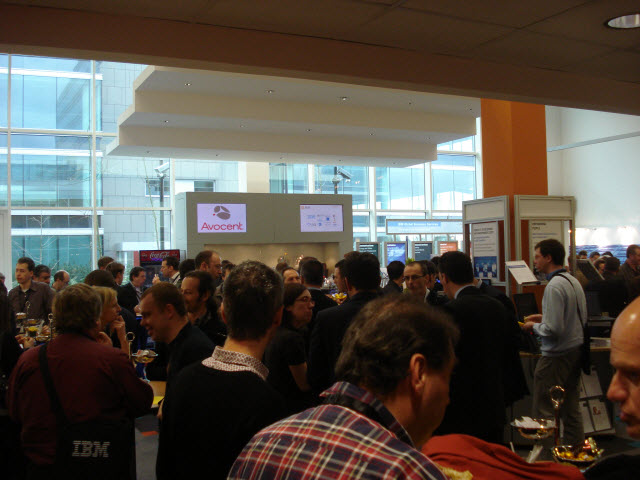
BlugPeople

My session on DAOS went well, although I was a bit nervous because of the fact that I had never before spoken at an international conference.

Thanks to Theo for immediate response of what attendees said about my session.
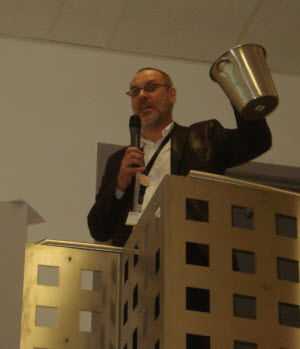
The bar opened at 4 pm and Theo raffled sponsor’s giveaways. ( T-Shirts, books, umbrellas and even a license for a Ytria EZ suite).

Back at the hotel, we had at least 30 minutes to change clothes before we drove downtown Brussels. Beer, wine and great food were a perfect closing of a perfect day.

We celebrated Matt White’s 8th blogging anniversary. Don’t know what the waiter was thinking when we start singing “Happy blogging .. “.

Thanks again to Theo and the team ( IBMers and Non-IBMers )  for making this conference a great and successful event. It was also a pleasure to meet the other speakers.


BLUG: Only few seats left

Next week on 30-March-2010, BLUG starts. This FREE, one day event will take place in the IBM Forum, Bourgetlaan 42, Zaventem (Brussels).

According to an email I received yesterday, there are a few seats left. If you have not yet registered, go ahead and grab your seat … NOW!!

If you cannot make it to the conference, you can point your browser to www.blug.be/liveblogging to follow along. Live Blogging will start on Tuesday around 9.00h (CET).


Book Review: Grok 1.0 Web Development from Packt Publishing

I’ve been asked by PACKT publishing to review a new book  Grok 1.0 Web Development.

Grok? Who or what is Grok?

“Grok is a web application framework for Python developers. It is aimed at both beginners and very experienced web developers. Grok  has an emphasis on agile development. Grok is easy and powerful.”

Grok 1.0 Web Development is written by Carlos de la Guardia and has been first published in Feb 2010.

The book is intended for developers more or less familiar with the concepts of web applications who want to write their applications using the Python programming language. No familiarity with Zope is assumed from the start. The approach is practical, focusing on getting working code right from the beginning.

What you will learn from this book

  • Basic concepts of the Zope Component Architecture
  • Use Zope Page Templates to produce HTML pages
  • Design efficient applications using models and views
  • Use Grok’s automatic form generation mechanisms
  • Add selectable themes or skins to your applications
  • Index content from the models you defined and learn how to search this content by querying the catalog, including full text search
  • Understand how the Zope Object Database works and how simple and useful it is
  • Easily connect to other relational databases using SQLAlchemy
  • Create extensions to your applications
  • Understand the various options to deploy your Grok application, and use buildout—a Python-based build system for deploying applications—to create a repeatable deployment

The author does a great job explaining a very, very complex software system.  A lot of the Zope specific details were left out as this was a book on Grok, but when the detail was required, it was very simple to digest and understand.

As always, there is a free chapter available for your reading pleasure. Chapter No 5 : Forms. You can also order the book following this link.


Search for auto-populated group members failed for group …

I tried to get the auto-populate group feature to work in one of our branch offices, but always got a

“Search for auto-populated group members failed for group TEST.: Error looking up name on LDAP Server; See server log for further details.”

error message. I finally gave up because I could not figure out, why the feature did not work on this server.

After migrating the server from Windooze to Linux, the error still occurs and I finally found the cause for the failure.

Directory assistance is running on the server and we have 5 additional address books enabled. One of this address books is not derived from the PUBNAMES.NTF template. And this is it. So simple, isn’t it?

When I disable the address book in question, the autopop feature works without any issue.

Although there is a technote that says that “private” address books can be problematic, directory assistance worked for us for us without any problems.


DAOS: Get FileCount and RepositorySize on Linux

Migrated a Windooze server to Linux today. The files on the server are DAOS enabled and I wanted to get the number of files in the DAOS repository and the overall filesize.

Here is a small shell script that does the job

#!/bin/sh
REPOSITORY=/local/daos
OUTFILE=/local/daos.txt
fCount=`find $REPOSITORY -type f | wc -l`
fSize=`du -ksb $REPOSITORY`
IFS=”/”
array=($fSize)
fDate=$(date +”%d-%m-%Y”)
echo $fDate / $fCount / ${array[0]}>> $OUTFILE

On a daily basis, triggered by cron, it appends a new line like this one to the file defined in the OUTFILE variable

12-03-2010 / 26235 / 18743907789

You can now use the file to create charts with Dojo for example. Maybe there is a better way to accomplish the aim, but this works for me and perhaps it is useful for someone else.


tmpProposedStartTime_Actual – Wrong datatype

Got a phone call from one of my users. He told me that he is not able to accept an ivitation for a meeting. Instead the following error message occurs when he tries to open the document from his inbox.

I searched the KnowledgeBase but could not find any hint, how to solve the problem. If you google for “tmpProposedStartTime_Actual” you only get two hits.

tmpProposedStartTime_Actual is a computed for display field on the (Notice) form.

The field formula references to some fields starting with “new”. I opened the document with ScanEZ and found that none of these fields contain any value ( for whatever reason ).

I deleted the fields from the document and the user was able to open the invitation.


Entwicklercamp 2010 – Day 3

As usual, the conference started at 8:30 with SpeedAgendaing and a short briefing.

I had to go and setup my environment for my presentation about “C/C++ API for Beginners” before all the speakers had shown their slides to give the audience an impression, what the session is about.

My session went well and I finished talking one minute before time. I got good response from the audience. I must admit that I totally forgot to do the demoes on the Linux client to show that the code would not only work on Windooze. Sorry for that …

After my session I attended Tim Pistor‘s presentation about Webservices. It was Tim’s first appearence as a speaker. He was a bit nervous and went thru the slides and demo code like a whirlwind.

Do you know that you even can brew coffee with Notes??  Tim and his “assistant” Werner Motzet had pimped a “Senseo” to show how you can get a cup of coffee or two using Lotus Notes and webservices. Great job, guys.

After lunch, Niklas Heidloff was on stage for the CGS. He demonstrated 20 projects, widgets and gadgets from OpenNTF in 60 minutes. Did you already watch the video he has taken during the conference asking for a statement about OpenNTF?

It was a great conference and crowded like never before. The team around Rudi again did a professional job running the conference. And so did the hotel staff.

Julian Buss wrapped up his impressions here ( in german ).


Entwicklercamp 2010 – Day 2

The day started at 8:30 with Rudi’s briefing for the day, followed by the daily speed agendaing. Some speakers had not provided their slides as requested and submitted them via mail during the speed agendaing, which made it a bit confusing for the audience.

With a delay of about 10 minutes the first session started at 9:10 am. Bernd Hort presented “Dojo and Notes” . Easy examples but great effects with only a few lines of code.

After lunch, Niklas Heidloff presented “OpenNTF projects and Dojo”. After a short introduction to OpenNTF he showed how Steve Castledine and Niklas modified the old discussin template where they used all possible techniques from Notes and Domino 8.5.x to improve the user expierience. The room was crowded and Niklas had some problems to put all the exiting stuff into 90 minutes. .

At the moment I’m attending Julian Buss talking about X-Pages in the client.Room is also crowded and it seems to get interesting. Have to stop now to concentrate on Julians’s presentation.


Entwicklercamp 2010 – Day 1

Day 1 of Entwicklercamp 2010 is over. 212 attendees from Germany, Austria, Liechtenstein, Swiss.

Prominent speakers from the US ( Andrew Pollack, Rocky Oliver … ) .

Maureen Leeland opened the conference with a keynote on Lotus Notes Designer 8.5.1 and beyond.

After lunch I attended Bob Balaban’s session on using COM from C++, VB.net and C#. Good tipp on how to get the h files from .tlb, Bob.

Matthias Bierl did a great session on how to create server addin tasks with JAVA.  In the evening there was a razzle and the usual “Questions and answers” hour. I was surprised to hear a lot of questions regarding WebServices. Had expected more on XPages.

5 parallel tracks ( including a hands-on session ) Great content, great speakers. The hotel staff is doing a great job, too.  Tomorrow we will have a full day with 4 sessions in 5 tracks.


Modify Header / Footer items via Lotusscript ( and API )

Header / Footer items are of type Richtext and you cannot modify them directly using standard LotusScript.

I’ ve put together all the necessary code and wrapped the API calls into a class to achive the goal. The class works on Windows and Linux. Mac support is possible but I have no Mac to test with.

In addition the application contains code to get the size ( and other properties ) of embedded images in a richtext item. Another code snippet provides functionality to test if a richtext item is empty.

The code is an example to show how to access Notes RichText items on the CD Record level using LS2CAPI techniques.

The application is used as a sample database for EntwicklerCamp 2010, 10-Mar-2010, Gelsenkirchen, Germany.

OpenNTF: Download sample application

A word of warning: If you really not understand how the code works, DO NOT USE IT !!


I’ll be speaking at BLUG

Yesterady I received a mail from the organizers of the BLUG event on March, 30th in Brussels, Belgium that my session on DAOS has been approved.

Here is the session abstract:

Are your servers running out of disk space? Do you have more than one bit like attachment stored in your databases? Does a standard task like fixup lasts for ages or does your backup still runs during working hours? Do you have quota enabled and your users are asking for more space?
If you can answer one or more of these questions with YES, than this session is for you.
Maximize the disk space savings provided by Domino Attachment and Object Service (DAOS) and ensure that your environment is properly configured for best performance with this feature. Save more space by simply enable design and document compression. Make sure that your attachments use best compression too. Reduce network bandwidth when replicating databases between servers and enhance the quota but not use more disk space.
Target audience is administrators or decision makers who want to know more about some older but not yet used space savers and especially about DAOS.

The event is a FREE one day event.

Jump over to the BLUG website for more information about speakers and sessions.

The venue is near the airport and hotels are available at reasonable rates. Register today!!

Did I already mention that it is F R E E ?