Still No Traveler Download
I requested the download almost 48 h ago; still no answer. Wonder, how long it will take to get traveler.
I requested the download almost 48 h ago; still no answer. Wonder, how long it will take to get traveler.
If you do not know what [A-Za-z0-9]. means, you will have problems to use the new LiveText feature in Lotus Notes 8.0.1.
You have to learn how to write Regular Expressions otherwise you get stuck in this dialog box.

So, no excuse not to start to learn how to use and get the most out of Regular Expressions
Daniel Silva (Campinas, SP, Brazil) posted answers to the question, if the new Service Pack 5 to Blackberry Enterprise Server 4.1 will support Domino 8.0.1 and the 64-bit version of Windows 2003 server.
“Requested by those who have used our popular Lotusphere Sessions database, we have built a Journal database containing all the sessions listed on the official EntwicklerCamp site. This database is based on the personal ND6 Journal with a few added views, so it should synch with the Palm Pilot and other smart phones, but it also contains a wealth of useful information for planning out your schedule. Modify it all you want or make suggestions at Ben.Langhinrichs@GeniiSoft.com for ways that we can make it more useful for you. ”
Ben Langhinrichs
Thank you for this, Ben!
You can download Lotus Notes Traveler 8.0.1 from here.
To be eligible to obtain entitlement to a license of Lotus Notes Traveler software, customers must possess a license and an active software maintenance contract.
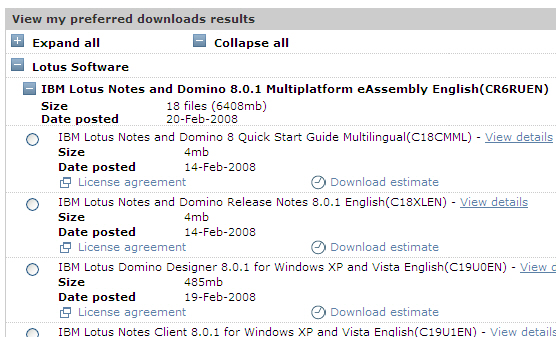
Since a few minutes, the latest release of Lotus Notes and Domino ( 8.0.1 ) is available for download on Passport Advantage.
Not yet, but on Monday, 25-Feb-2008 ( 1pm GMT ) you can register for ILUG 2008.
The event will once again be held in Dublin, Ireland. It will start on Wednesday morning, June 4th and will run through the afternoon of Friday,June 6th. The event will be held at the Griffith Conference Center. The organizers are in the process of planning the agenda and gathering speakers. A high level of quality is guaranteed, both in terms of speakers and content. With an additional day this time, you’ll be getting even *more* than last year!
So do not miss Monday, 25-Feb-2008. Seats might be “sold out” in minutes 🙂
I found this in the Lotus Software KnowledgeBase today:
“New to Lotus Notes® 8.0.1 mail files is a Mail Quota Status indicator which displays information about current mail file usage and allocation.”

For more details, read document #1291598 in the Lotus Software KnowledgeBase
Note: These dates are subject to change without notice.
{Source}
When multiple mail boxes are enabled, they are titled mail1.box, mail2.box, and so on and the router uses these mail boxes for routing messages.
To force the router to use “mail.box”, add the parameter to the notes.ini file:
Mail_Enable_Mailbox_Compatibility=1
The parameter keeps the “mail.box” file and still will create mail2.box, mail3.box, and so on.
This is useful if you have a third party applications that requires the existence of a “mail.box”.
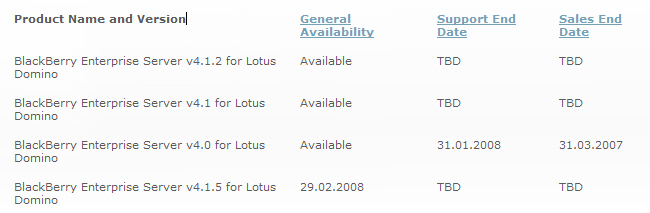
A lot of buzz is already around about the upcoming release of the Blackberry (Rubus fruticosus L. agg.) Enterprise Server 4.1.5 release.
On 10-Jan-2008 I added a reminder to my calender pointing at 14-Feb-2008 as the release date for BES 4.1.5. I got this information not from my crystal ball but from the Software Support Life Cycle page on http://blackberry.com.
Seems that the entry has been removed in the meantime …
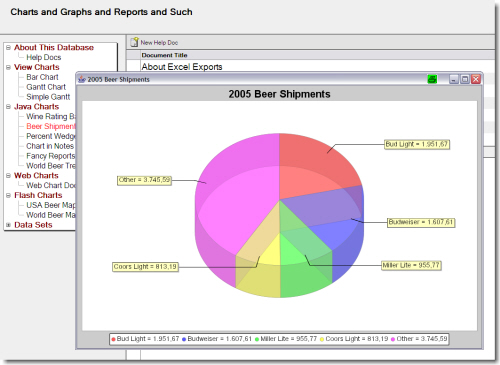
This is the database used by Rob McDonagh and Julian Robichaux in their Lotusphere 2008 session BP210: Reports, Charts, and Graphs in IBM Lotus Notes.
Lotus Notes stores the currently used client version for each user in the user’s person record in the Domino Directory.
It also stores the client version previously used. The information is automatically updated by the Notes client.
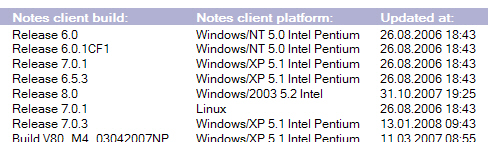
One of many new feature in Notes / Domino 8 is a Notes client version view in the Domino Directory.
The Domino Directory contains a People – by Client Version view that you can use to quickly see what versions of the Notes client are deployed on users’ computers in your domains. ( from: What’s new in IBM Lotus Domino 8 and 8.0.1? )
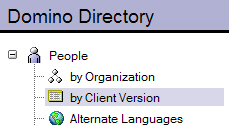
The view looks like this
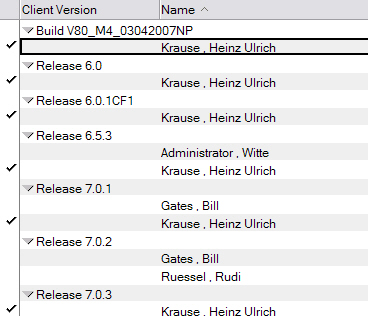
Indeed, it shows the client versions in your domain. But can it really be used to “quickly see what versions of the Notes client are deployed on users’ computers in your domains”? NO. The view displays ALL releases ever used in your domain. Not very useful.
I changed the view to only display the currently used client version as category. The main problem when designing the view was the fact the the client version information is stored in different fields in the person record. In addition to this, it is stored unsorted.
So a simple @Subset command to get the first ( or last ) entry of the ClntBld field does not neccessarily return the Notes Client version that is currently used by a user.
A great function which is available from version 6 on is @Sort. @Sort can be used in view columns and the greatest trick is custom sorts using the [CustomSort] keyword.
The first column ( categorized, descending ) of the new view contains the following formula.
_list:= ClntBld  + " - "  + @Text(@ToTime(ClntDate)) ;
_Sorted:=@Sort(_list; [CustomSort];
@ToTime(
@Trim(@RightBack($A; " - "))
) < @ToTime(
@Trim(@RightBack($B; " - "))
)
);
@Subset(@LeftBack(_Sorted; " - ");1)
Parts of this formula are 'stolen' from Rocky Olivers presentation 'AD 304 - Formula Follies and LotusScript Lunacy: Coding Feats that Will Amaze'.
The "All Releases" column contains the same formula, except the last @Subset command. The option for multiple values is set to "New Line".
The result looks like this.
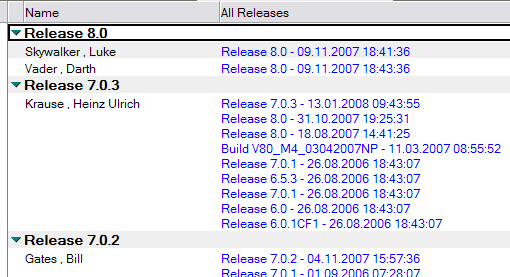
This gives you a better overview about the client versions currently in use than the original view shipped with release 8 of Lotus Notes / Domino.
 Troy Reimer of SNAPPS donates LotusScript JSONWriter and JSONReader to the community.
You can download Version 1.0 of JSONReader and JSONWriter here.
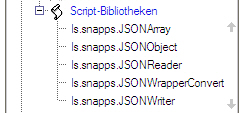
The database (json.nsf) contains LotusScript classes for parsing and creating JSON text.
These classes are contained in five script libraries: ls.snapps.JSONArray, ls.snapps.JSONObject, ls.snapps.JSONReader, ls.snapps.JSONWriter, and ls.snapps.JSONWrapperConverters.
The JSONArray and JSONObject classes are wrapper classes that are used by the JSONReader class. Additional information can be found in the “Help – About This Database” document.
The JSON LotusScript Classes are also available on OpenNTF.

You can use @ServerAccess to check if a specified user has a specified administrative access level to a server. For a list of keywords to represent the access level you want to check for take a look at the designer help either on your local client or on the web.
But what to do if you want to check the server access level using Lotus Script? The help document does not give you a cross reference to Lotusscript.
In this case, the Evaluate statement is your friend.
For further information about how to use Evaluate I recommend to read the following article on DeveloperWorks: “Simplifying your LotusScript with the Evaluate statement”
The following function uses evaluate and @ServerAccess to make the @function available in LotusScript.
Function atServerAccess (
sAction As String, sUserName As String, sServerName As String ) As Boolean
  Dim vAccess As Variant
  vAccess =
   Evaluate(|@ServerAccess(| + sAction + |; "| + sUserName_
                + |"; "| + sServerName + |")|)	atServerAccess = Cbool(vAccess(0))
End Function
Here is a sample of how to call the function
Sub Click(Source As Button)
  Dim sUser As String
  Dim sServer As String
  Dim sAction As String
  sUser = "Bill Gates/Microsoft"
  sServer = "MyServer/foo"
  sAction = "[RemoteAccess]"

  ' returns TRUE of FALSE
  Msgbox atServerAccess ( sAction, sUser, sServer )
End Sub
I ran a compact on a Domino 7.0.2 ( Linux ). On the console the following line occurred:
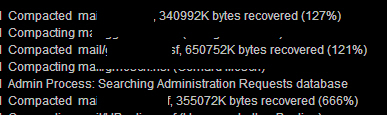 When I went to school ages ago, more than 100% were not possible. Is this some kind of Borg technologie built into Domino?
2008 is a leap year again. The Gregorian calendar, the current standard calendar in most of the world, adds a 29th day to February in 97 years out of every 400, a closer approximation than once every four years. This is implemented by making every year divisible by 4 a leap year unless that year is divisible by 100. If it is divisible by 100 it can only be a leap year if that year is also divisible by 400.
So, in the last millennium, 1600 and 2000 were leap years, but 1700, 1800 and 1900 were not. In this millennium, 2100, 2200, 2300, 2500, 2600, 2700, 2900 and 3000 will not be leap years, but 2400 and 2800 will be. You can find numerous examples in almost every programming language of how to determine if a year is a leap year or not.
In LotusScript as well as with @Formula you can “adjust” a given date to another date depending on the parameters you use. So the easiest method to determine a leap year is to set the date to March, 1st of the given year and “substract” one day. If the resulting date is Feb., 29th, the year is a leap year.
Here is my @Formula
_date:=[01.03.1700];
@Prompt([Ok];"Last Day";@Text( @Day( @Adjust( _date; 0;0;-1;0;0;0 ) ) ) )
I expected a 28 in the message box, but it prompted 29 ! Oups …
I tried the same using LotusScript and the NotesDateTime class
Sub Click(Source As Button)
	Set dt = New NotesDateTime( Datenumber( 1700 ,3, 1) )
	Call dt.AdjustDay (-1)
        Msgbox dt.Localtime
End Sub
Guess what it returns. 29.02.1700 ! Another oups …
Seems that IBM / Lotus uses another calender than the Gregorian calendar. No surprise is that 🙂
You might want to try the next piece of code and watch what happens …
Sub Click(Source As Button)
	Set dt = New NotesDateTime( Datenumber( 1700 ,3, 1) )
	Call dt.AdjustDay (-1)
	Msgbox Day (dt.Localtime)
End Sub
An error message occurs, stating that there is a “Type mismatch”. I guess that some subroutines deep in the core code are not sure which calendar to use; Gregorian or IBM calendar. By the way, you get the same error when replacing the 1700 by 1500, 1400, 1300, 1100 and 1000.
If you happen to travel to the year 1700 using a time machine, be careful when planning a meeting at the end of February …
RIM) announced a series of updates for its BlackBerry® platform that include enhanced messaging and collaboration, simpler management, enhanced security and expanded application development support.
These new BlackBerry platform enhancements are scheduled to be phased in to new software releases during the first half of 2008.
My favorites are
For more information, read this press release